
- The Backend Theory
- onOctober 8, 2025
5 Backend Principles to Protect Your Application from Day One
1. Introduction: Navigating the Nuances of Modern AI
The landscape of artificial intelligence is evolving at an unprecedented pace, transforming industries, reshaping workforces, and redefining our interaction with technology. From smart assistants that schedule our days to sophisticated algorithms that drive medical diagnoses, AI’s presence is ubiquitous. However, amidst this rapid progression, a critical challenge emerges: the increasingly blurred lines between foundational AI concepts and their more advanced, autonomous manifestations. Understanding the distinctions is no longer a luxury but a necessity for anyone looking to harness its true potential.
This dynamic environment often leads to misconceptions, particularly when discussing the capabilities and implications of advanced AI systems. Strategic investment, effective implementation, and ethical deployment hinge on a precise understanding of what each term truly signifies. Therefore, navigating the nuances of these concepts is paramount to making informed decisions and avoiding costly misapplications.
This comprehensive guide aims to demystify these powerful technologies by providing clear definitions and a comparative analysis of AI vs Agentic AI vs Agentic Automation. Our goal is to empower you with a precise understanding of each, enabling you to better comprehend their roles, capabilities, and the transformative impact they hold for the future.
The Exploding AI Landscape
- Brief overview of AI’s current impact and ubiquity: Artificial intelligence is rapidly integrating into every facet of our lives, from personalized recommendations on streaming platforms to advanced analytics in scientific research. Its ability to process vast datasets and derive insights is fundamentally changing how businesses operate and how individuals interact with the digital world.
- Challenge of keeping up with new terminology and concepts: As AI advances, so does its lexicon. Terms like Machine Learning, Deep Learning, Generative AI, and now Agentic AI and Agentic Automation, flood the discourse, often leading to confusion and an incomplete understanding of their specific functionalities.
Why Differentiating Matters
- Importance for strategic investment, implementation, and ethical considerations: A clear distinction between these AI paradigms is crucial for organizations planning their technological roadmaps. Misidentifying a system’s true capabilities can lead to misplaced investments, inefficient deployments, and significant ethical challenges, particularly concerning autonomy and accountability.
- Avoiding misconceptions and misapplications: Without a clear understanding, businesses might expect autonomous decision-making from basic AI systems or underestimate the complexity and governance required for truly autonomous systems.
Purpose of This Guide
- Clear definitions and comparative analysis of AI, Agentic AI, and Agentic Automation: This guide will systematically break down each concept, offering precise definitions and highlighting their unique characteristics.
- Empowering readers with a precise understanding: By the end of this post, you will possess a robust framework for distinguishing these critical AI advancements, enabling more informed discussions and strategic planning.
2. Understanding the Foundation: Artificial Intelligence (AI)
At its core, Artificial Intelligence (AI) serves as the broad, foundational umbrella encompassing any system designed to simulate human cognitive functions. It’s the starting point for understanding more specialized branches, providing the conceptual groundwork upon which more advanced forms are built.
AI: The Broad Definition
- Systems designed to perform tasks that typically require human intelligence: This includes a wide array of capabilities such as visual perception, speech recognition, decision-making, and translation between languages.
- Mimicking cognitive functions like learning, problem-solving, perception: AI systems strive to replicate the sophisticated ways humans interact with and understand the world, processing information to achieve specific outcomes.
Core Pillars and Subfields
AI isn’t a monolithic entity but a diverse field with several key subfields that power its capabilities:
- Machine Learning (ML): A subset of AI that enables systems to learn from data without explicit programming. Through algorithms, ML models identify patterns and make predictions or decisions.
- Deep Learning (DL): An even more specialized subset of ML, utilizing neural networks with multiple layers (hence “deep”) to learn complex patterns, often excelling in tasks like image and speech recognition.
- Natural Language Processing (NLP): Focuses on the interaction between computers and human language, allowing machines to understand, interpret, and generate human text or speech.
- Computer Vision (CV): Equips machines with the ability to “see” and interpret visual information from the world, used in facial recognition, object detection, and autonomous vehicles.
- Rule-based systems vs. data-driven approaches: Early AI often relied on predefined rules programmed by humans (expert systems), while modern AI largely embraces data-driven approaches, learning from vast datasets to infer rules and make decisions.
Reactive vs. Limited Memory AI
Within the spectrum of AI, early categorizations help illustrate its foundational nature:
- Discussion of basic AI types (e.g., chess programs, simple classifiers): These early forms of AI are often reactive, responding to present stimuli based on pre-programmed rules. For instance, a chess AI might evaluate moves purely based on the current board state without recalling past game moves or player psychology.
- AI’s reliance on predefined rules or human-defined goals for task execution: Many conventional AI systems operate within narrowly defined parameters, requiring human input to set goals, define tasks, and often monitor performance. Their “intelligence” is highly specialized and generally lacks the capacity for independent action beyond its programmed scope.
“Traditional AI excels at pattern recognition and prediction within defined datasets, acting as a powerful tool for analysis and insight generation. Its intelligence is often a reflection of the data it’s trained on and the rules it’s given.”
3. Introducing Autonomy: What is Agentic AI?
Building upon the foundational principles of AI, Agentic AI introduces a critical new dimension: autonomy. This isn’t just about processing information; it’s about systems that can perceive their environment, reason about their goals, and act proactively to achieve them, largely without constant human intervention. They embody what are often called Intelligent Agents.
Defining Agentic AI: Agency and Goals
- AI systems endowed with the ability to act on their own behalf: Unlike reactive AI that merely responds to input, Agentic AI possesses a degree of independence. It can initiate actions based on its internal state and understanding of the environment.
- Possession of a defined goal or objective that guides their actions: A key characteristic of Agentic AI is its goal-orientation. These systems are designed not just to perform a task but to pursue a specific objective, adjusting their behavior as needed to reach that goal. This often involves planning and decision-making over extended periods.
- Not just processing information, but acting upon it: The shift from merely understanding data to actively influencing the environment distinguishes Agentic AI. It bridges the gap between raw data analysis and actionable outcomes.
The Perceive-Think-Act Loop
The operational framework for Agentic AI is often described by the “Perceive-Think-Act” loop, a continuous cycle that enables autonomous behavior:
- Sensors to perceive the environment: Agentic AI systems gather data from their surroundings, whether through digital sensors (e.g., system logs, network traffic, market data) or physical sensors (e.g., cameras, lidar, microphones).
- Processing to interpret perceptions and plan actions: The collected data is then analyzed using various AI techniques (ML, DL, NLP) to understand the current state of the environment, identify patterns, predict future states, and formulate a plan to achieve its goal. This involves reasoning and problem-solving.
- Actuators to execute actions within the environment: Based on the plan, the Agentic AI then performs actions. These could be digital commands (e.g., reconfiguring a server, sending an email, adjusting a trade) or physical movements (e.g., a robot arm grasping an object, a drone flying a path).
- Iterative and continuous self-correction: This loop is not a one-time process but an ongoing cycle. Agentic AI continuously perceives the environment, evaluates the impact of its actions, and adjusts its plans and behaviors in real-time, demonstrating adaptability.
Key Characteristics: Autonomy, Proactivity, Adaptability
- Autonomy: Operating without constant human intervention. Once configured with its goals, an Agentic AI system can largely manage itself, making decisions and executing tasks independently. This is a significant leap from traditional AI, which typically requires more direct human oversight.
- Proactivity: Initiating actions to achieve goals, rather than just reacting. Instead of waiting for a command, an Agentic AI will actively seek opportunities or pathways to fulfill its objectives, anticipating needs and mitigating potential issues.
- Adaptability: Modifying behavior based on environmental changes and feedback. Agentic AI is not rigid. It can learn from experience, adjust its strategies when faced with unexpected events, and optimize its performance over time, embodying principles of Cognitive Automation.
“Agentic AI marks the transition from ‘smart tools’ to ‘intelligent teammates.’ It’s about systems that don’t just solve problems given to them, but actively identify problems and autonomously work towards solutions.”
4. Operationalizing Intelligence: What is Agentic Automation?
While Agentic AI defines the capabilities of an autonomous, goal-oriented system, Agentic Automation describes the practical application and deployment of one or more Agentic AI systems to manage and optimize complex, end-to-end processes or workflows. It’s where the theoretical intelligence of Agentic AI meets the operational demands of the real world, leading to Advanced Process Automation.
From Agentic AI to Real-World Application
- Leveraging Agentic AI for orchestrating tasks and processes: Agentic Automation takes the autonomous decision-making and proactive nature of Agentic AI and applies it to sequences of operations. This involves designing systems where agents collaborate or manage sub-processes to achieve larger business objectives.
- Deployment in enterprise and industrial settings: This is where Agentic Automation truly shines, transforming how businesses handle everything from supply chain logistics to IT operations, customer service, and manufacturing.
Integrating Agents for Process Optimization
Agentic Automation often involves a sophisticated architecture where multiple intelligent agents work in concert:
- Agentic AI systems working in concert to manage complex workflows: Imagine a supply chain where different agents handle inventory management, logistics optimization, and demand forecasting, all communicating and coordinating to ensure smooth operations.
- Autonomous decision-making at various stages of a process: Each agent, within its defined scope, can make real-time decisions, adapt to changes, and overcome unforeseen challenges without direct human intervention for every step.
- Examples: supply chain, cybersecurity, customer service automation:
- Supply Chain: An Agentic Automation system might dynamically reroute shipments based on real-time traffic, weather, and inventory levels, optimizing delivery times and costs.
- Cybersecurity: Agents can continuously monitor network activity, autonomously detect novel threats, isolate compromised systems, and even initiate remediation actions, providing proactive defense.
- Customer Service: While basic chatbots respond to queries, Agentic Automation could involve agents that not only answer questions but also proactively offer solutions, escalate complex issues to human agents with all relevant context, and even perform follow-up actions like processing refunds or scheduling appointments.
Beyond RPA: Intelligent, Goal-Driven Workflows
It’s crucial to distinguish Agentic Automation from traditional Robotic Process Automation (RPA):
- Distinction from traditional Robotic Process Automation (RPA) which is rule-based and less adaptive: RPA is excellent for automating repetitive, rule-based tasks with high accuracy, like data entry or invoice processing. However, it typically lacks the intelligence to handle exceptions or adapt to changing conditions without human reprogramming.
- Agentic Automation handles variability, exceptions, and requires less human intervention for dynamic scenarios: In contrast, Agentic Automation leverages the adaptability and problem-solving capabilities of Agentic AI. It can interpret nuanced situations, make judgments, and even learn from new data to improve its processes over time, leading to truly Goal-Oriented AI. This means it can navigate unforeseen obstacles, recover from errors, and continually optimize its workflow, making it far more resilient and powerful than conventional automation.
“Agentic Automation isn’t just about doing tasks faster; it’s about making entire operational processes smarter, more resilient, and self-optimizing. It transforms static workflows into dynamic, intelligent ecosystems.”
5. The Core Distinctions: A Comparative Analysis
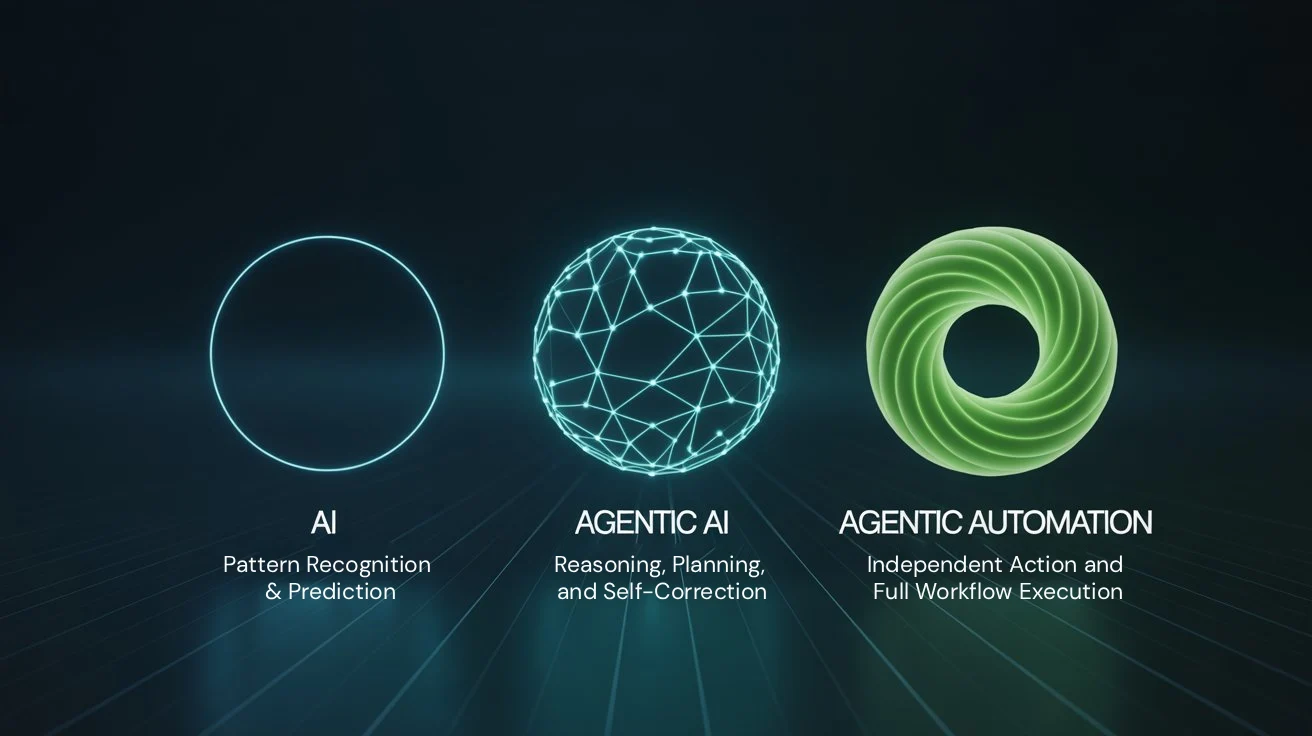
To truly grasp the capabilities and implications of modern AI, understanding the core distinctions between AI vs Agentic AI vs Agentic Automation is essential. While they are intrinsically linked, representing a progression of complexity and autonomy, each category serves distinct purposes and possesses unique operational characteristics.
Defining Lines: Autonomy and Goal-Orientation
- AI: Often reactive, human-defined goals, limited autonomy. Traditional AI systems typically operate within predefined parameters, executing specific tasks based on explicit instructions or patterns learned from data. Their “goals” are directly set by humans, and their autonomy is constrained to the task at hand, requiring significant human oversight for broader objectives.
- Agentic AI: Proactive, self-defined or high-level human-defined goals, significant autonomy. These systems possess a greater degree of independence. While their ultimate objectives might be set by humans (e.g., “optimize energy consumption”), the Agentic AI itself determines the sub-goals and actions needed to achieve that objective, acting proactively without constant prompting.
- Agentic Automation: Application of Agentic AI to automate complex, multi-step processes autonomously. This is the deployment of one or more Agentic AI systems to manage entire workflows. The autonomy here is at the process level, where the system orchestrates various intelligent agents to achieve a comprehensive, often business-critical, outcome.
Scope of Operation: From Task to System
- AI: Typically focused on specific tasks (e.g., image classification, natural language translation). Its scope is narrow and specialized.
- Agentic AI: Manages a range of tasks to achieve a broader goal. An Agentic AI agent might handle multiple interconnected sub-tasks to complete a larger objective, demonstrating a wider operational scope.
- Agentic Automation: Orchestrates entire systems, processes, or workflows. Its scope is holistic, spanning multiple functions and departments to automate complex end-to-end operations. This often involves intricate AI Architectures.
Dependency on Human Oversight
- AI: High to moderate human intervention for goal setting, monitoring, and course correction. Many AI systems act as powerful tools that augment human capabilities but still require humans to guide, validate, and often supervise their outputs.
- Agentic AI: Moderate to low intervention once goals are set, requires monitoring. While Agentic AI operates with greater independence, human oversight is still crucial for setting high-level objectives, monitoring performance, evaluating ethical implications, and intervening in unforeseen critical situations.
- Agentic Automation: Low human intervention, focuses on system-level management and exception handling. The goal here is hands-off operation for routine processes. Human intervention is primarily reserved for defining the overall strategic intent, managing exceptions that the system cannot resolve, and continuous improvement based on performance analytics.
Decision-Making Capabilities
- AI: Pattern recognition, prediction, classification based on data. Decisions are typically output-based on learned patterns, such as identifying an object in an image or predicting a trend.
- Agentic AI: Planning, reasoning, learning, and self-correction to achieve goals. It makes decisions about *how* to achieve its goals, involving sequential planning, adapting to new information, and refining its approach. This involves a higher level of cognitive function.
- Agentic Automation: Orchestration of distributed decisions across a process, dynamic adaptation. This involves coordinating decisions made by multiple agents, potentially in real-time, to maintain the integrity and efficiency of a larger automated process. It’s about intelligent system-level control.
6. Real-World Applications and Transformative Impact
The progression from fundamental AI to Agentic AI and then to Agentic Automation represents a significant leap in capabilities, each layer building upon the previous one to deliver increasingly sophisticated and impactful solutions across various industries.
Traditional AI in Action
These applications leverage AI’s ability to process data, recognize patterns, and make predictions, often augmenting human decision-making:
- Recommendation engines (Netflix, Amazon): These systems use collaborative filtering and machine learning to analyze user behavior and suggest movies, products, or content that align with individual preferences, vastly improving user experience and engagement.
- Predictive analytics (fraud detection, sales forecasting): AI algorithms analyze historical data to identify suspicious patterns indicative of fraud in financial transactions or predict future sales trends based on market conditions, customer behavior, and seasonal fluctuations.
- Image and speech recognition (Siri, facial unlock): Technologies that convert spoken language into text, recognize faces for authentication, or identify objects in images are powered by advanced AI, primarily deep learning, enabling intuitive human-computer interaction.
Agentic AI Use Cases
Here, the emphasis shifts to autonomous, goal-oriented systems that proactively act within their environments:
- Personalized AI assistants managing schedules and tasks autonomously: Beyond simple voice commands, Agentic AI assistants can learn preferences, anticipate needs, proactively suggest optimal meeting times, reschedule appointments based on conflicts, and even book travel arrangements, all without explicit, step-by-step human instruction.
- Financial trading bots optimizing portfolios based on market changes: These intelligent agents constantly monitor global markets, analyze vast quantities of data (news, sentiment, economic indicators), and autonomously execute trades to achieve predefined investment goals, adapting strategies in real-time to market volatility.
- Autonomous exploration robots (e.g., Mars rovers): Equipped with Agentic AI, these robots can navigate complex terrains, identify scientific targets, collect samples, and even make decisions about their next moves based on sensor data and mission objectives, operating with minimal human guidance over vast distances and time delays.
- Dynamic game AI characters: In video games, Agentic AI creates non-player characters (NPCs) that can learn player behavior, adapt their strategies, and pursue dynamic goals, making games more challenging and immersive.
Agentic Automation in Enterprise
This is where Agentic AI is deployed to manage entire operational processes, transforming enterprise efficiency and resilience:
- Self-optimizing supply chain management systems: An Agentic Automation platform can integrate data from manufacturing, logistics, inventory, and sales to autonomously adjust production schedules, reroute shipments, and manage stock levels to meet fluctuating demand, minimize costs, and prevent disruptions.
- Autonomous cybersecurity threat response and remediation: Instead of just detecting threats, Agentic Automation systems in cybersecurity can identify anomalies, classify attacks, automatically isolate affected systems, patch vulnerabilities, and even restore compromised data, all within seconds, significantly reducing response times and human effort.
- Intelligent IT operations (AIOps) for self-healing systems: AIOps platforms powered by Agentic Automation continuously monitor IT infrastructure performance, proactively identify potential issues before they impact users, and autonomously execute remediation actions like restarting services, reallocating resources, or scaling up infrastructure.
- Smart manufacturing and warehouse automation: In smart factories, Agentic Automation can orchestrate robotic systems, production lines, and quality control processes to dynamically adapt to production changes, manage equipment maintenance proactively, and optimize material flow, leading to highly efficient and flexible operations.
Synergies and Future Potential
- How these layers build upon each other for increasingly sophisticated solutions: The progression demonstrates a clear pathway from basic data processing to truly intelligent, autonomous operational management. Each layer adds a new dimension of capability, culminating in systems that can perceive, reason, plan, and act independently across complex environments.
- The potential for truly autonomous and self-managing enterprises: As these technologies mature, we are moving towards a future where enterprises can achieve unprecedented levels of efficiency, resilience, and adaptability through highly autonomous and self-optimizing systems.
7. Navigating the Future: Benefits, Challenges, and Ethical Considerations
The advent of Agentic AI and Agentic Automation heralds a new era of technological capability, promising profound benefits but also introducing complex challenges and critical ethical considerations. Understanding this duality is paramount for responsible development and deployment.
Advantages: Efficiency, Scalability, Innovation
- Unprecedented levels of operational efficiency and cost reduction: By automating complex processes and making real-time, optimal decisions, Agentic Automation can drastically reduce human error, improve throughput, and lower operational costs across industries.
- Ability to scale complex operations rapidly: Autonomous systems can scale operations far beyond human capacity, enabling businesses to expand quickly and handle increased demand without proportionate increases in human resources.
- Driving innovation in new products and services: The ability of Agentic AI to explore solutions and adapt opens doors for entirely new classes of products and services, from fully autonomous personal assistants to self-managing smart cities.
Challenges: Complexity, Control, Interpretability
- Increased system complexity and potential for unforeseen interactions: As autonomous systems become more sophisticated and interconnected, their internal logic and interactions can become incredibly complex, making them difficult to design, debug, and predict.
- Maintaining human oversight and control over autonomous actions: Balancing autonomy with human control is a critical challenge. Ensuring that humans can intervene, override, or understand why an Agentic AI took a particular action is vital for safety and accountability, especially with Machine Learning Agents.
- Difficulty in interpreting and debugging agentic decision-making (‘black box’ problem): Many advanced AI systems, particularly those using deep learning, are “black boxes,” meaning it’s hard to understand the exact reasoning behind their decisions. This poses significant challenges for auditing, troubleshooting, and building trust.
“The power of Agentic Automation lies in its capacity for dynamic adaptation. The challenge, however, is ensuring that this adaptation remains aligned with human values and intent, especially when operating in complex, unpredictable environments.”
Ethical and Governance Frameworks
As AI systems gain more autonomy, ethical considerations become more pressing:
- Need for robust ethical guidelines for autonomous systems: Developing clear, internationally recognized ethical guidelines is crucial to ensure that Agentic AI and Automation are developed and deployed responsibly, considering potential biases, impacts on employment, and societal implications.
- Ensuring accountability, transparency, and fairness: When an autonomous system makes a harmful decision, who is accountable? Establishing frameworks for transparency in decision-making, ensuring fairness in outcomes, and assigning clear accountability is paramount.
- Regulatory landscape and compliance for Agentic Automation: Governments and regulatory bodies are grappling with how to regulate autonomous AI, especially in critical sectors like healthcare, finance, and transportation. Compliance with emerging regulations will be a significant factor for businesses adopting these technologies.
The Road Ahead for Intelligent Systems
The journey towards more intelligent and autonomous systems is ongoing:
- Continuous evolution towards more general and adaptable agentic capabilities: Future developments will likely focus on making Agentic AI even more versatile, capable of handling a broader range of tasks and learning from fewer examples, moving closer to general intelligence.
- The imperative for responsible development and deployment: As the distinction between AI vs Agentic AI vs Agentic Automation becomes clearer, so too does the responsibility of developers, policymakers, and users to ensure these powerful tools serve humanity’s best interests.
Conclusion: Mastering the Spectrum of AI
Understanding the fundamental differences between AI, Agentic AI, and Agentic Automation is no longer academic – it’s a strategic imperative. We’ve journeyed from AI as the foundational intelligence, to Agentic AI as the autonomous, goal-oriented actor, and finally to Agentic Automation as the practical orchestration of intelligent agents for end-to-end process management. This progression represents an evolution in capability, autonomy, and potential impact. By grasping these distinctions, businesses and individuals alike can make more informed decisions, leverage these technologies effectively, and navigate the exciting, yet complex, future of intelligent systems. As AI continues its rapid advancement, your ability to precisely differentiate these concepts will be key to unlocking transformative opportunities and ensuring responsible innovation.
- The Backend Theory
- onOctober 8, 2025
Share On:
Previous Article
About

The Backend Theory
Intelligent software, beautifully built.
The knowledge hub of The Backend Theory. Delivering expert strategy and technical insights on the future of AI, Automation, and intelligent software solutions.
Linkedin
Twitter
Instagram
Github
Top Articles

5 Backend Principles to…
October 8, 2025

7 Metrics to Prove…
October 5, 2025
Difference between AI vs…
October 5, 2025
Technologies

Photoshop
Professional image and graphic editing tool.

Notion
Organize, track, and collaborate on projects easily.

Figma
Collaborate and design interfaces in real-time.

Illustrator
Create precise vector graphics and illustrations.
Subscribe For More!
Categories
- AI & Automation (3)
- Application Security (1)
- Artificial Intelligence (2)
- Development Strategy & Security (1)
- Tech Strategy (1)
